
Published: 11 October 2026 | Legionella Assessors
Rotherham Legionella Outbreak 2026: What Landlords, Businesses and Responsible Persons Need to Know
A recent investigation into Legionnaires’ disease cases in Rotherham, South Yorkshire, has brought Legionella water safety back into the spotlight. The UK Health Security Agency (UKHSA) is investigating a small number of cases and examining whether there is a common source of exposure.
For landlords, employers, property managers, schools, nurseries, care settings and business owners across Rotherham, Doncaster, Sheffield, Barnsley and the wider UK, the investigation is a timely reminder of the importance of effective Legionella risk management.
Understanding who is responsible for water safety, what the law requires and how to implement suitable control measures is essential.
Latest position – 11 October 2026
UKHSA has reported an increased number of Legionnaires’ disease cases associated with Rotherham. Investigations are continuing. No single source of the recent cases has been publicly confirmed in the reporting reviewed for this article. The wider public health risk has been described as low.
This article will distinguish the current investigation from a separately documented, longstanding Legionella contamination issue at a Rotherham social housing complex. A connection between the two has not been established.
What Has Happened in Rotherham?
On 7 October 2026, reports confirmed that UKHSA specialists were investigating a higher-than-usual number of Legionnaires’ disease cases associated with Rotherham.
UKHSA stated that it was working with Rotherham Council and other local partners to establish whether the cases were connected and to identify any potential common sources.
Dr Andy Irvine, Consultant in Health Protection at UKHSA Yorkshire and Humber, explained that some cases might be isolated incidents without a shared source.
At the time of writing, the published information reviewed has not established whether the recent cases originated from domestic properties, commercial premises, public buildings or another water system.
It would therefore be premature to attribute responsibility to a particular landlord, business or organisation. No arrests, charges or prosecutions directly connected to the new investigation have been identified in the public reports reviewed.
Source: BBC reporting on the UKHSA investigation, 7 October 2026 .
Rotherham Council Has Also Reported a Longstanding Social Housing Legionella Problem
Separate from the recent cases, official Rotherham Council records reveal that Legionella contamination has been an ongoing concern at a social housing complex.
At a council meeting on 9 September 2026, councillors raised questions about the situation, including the identity of the housing provider, the condition of the water system and the safety of residents.
The council confirmed that the complex was not owned or managed by Rotherham Council, but that its Public Health team was working with the social housing provider.
According to the council’s recorded response, remedial measures included:
- Chemical treatment of the water system.
- Removal of redundant pipework.
- Additional insulation to reduce heat transfer.
- Removal of an external pond and water feature.
- Further investigation and remedial work.
The council reported that Legionella levels had been significantly reduced, although a small number of outlets continued to produce positive test results.
The council also stated that there was no ongoing risk to residents at that time and that residents had been informed.
This is a documented water-system contamination issue. It should not be taken as proof that the October 2026 human cases originated from that housing complex.
Official source: Rotherham Metropolitan Borough Council – Council meeting, 9 September 2026 .
Why Is Legionella Dangerous?
Legionella bacteria can develop in man-made water systems when conditions favour bacterial growth. Legionnaires’ disease is a potentially fatal form of pneumonia that can develop when contaminated water droplets are inhaled.
Legionella bacteria can multiply in water temperatures between approximately 20°C and 45°C, particularly where water stagnates and nutrients such as scale, sediment or biofilm are present.
Potential sources include:
- Hot and cold water distribution systems.
- Showers and spray outlets.
- Water storage tanks and calorifiers.
- Cooling towers and evaporative condensers.
- Spa pools and certain specialist water systems.
- Infrequently used outlets and stagnant pipework.
Legionnaires’ disease is not normally transmitted from one person to another.
The HSE emphasises that suitable risk assessment and effective control measures are essential to managing exposure.
What Are the Legal Responsibilities of Landlords and Businesses?
The responsibility to manage Legionella risks is not restricted to hospitals, hotels or large industrial premises.
Under the Health and Safety at Work etc. Act 1974 and the Control of Substances Hazardous to Health Regulations 2002 (COSHH), relevant dutyholders must assess and control foreseeable risks from Legionella.
The HSE’s Approved Code of Practice L8 and technical guidance HSG274 explain how these responsibilities should be managed.
Private Landlords and Letting Agents
Private landlords have legal responsibilities to assess and control Legionella risks in rented accommodation.
For a typical domestic rental property with a simple water system, the assessment may be straightforward and the overall risk low.
The HSE does not require every domestic landlord to purchase a professional Legionella assessment or obtain a Legionella testing certificate.
However, the duty to assess and manage the risk still applies. Where a managing agent is involved, responsibility for maintenance and safety checks should be clearly defined in the management agreement.
Commercial Properties and Employers
Employers and people in control of commercial premises must identify and assess potential Legionella hazards and implement suitable precautions.
Depending on the premises and water system, these may include a written control scheme, temperature monitoring, maintenance, inspection, record keeping and regular review of the risk assessment.
Schools, Nurseries and Care Settings
Schools, nurseries, care homes, day centres and healthcare settings may have additional considerations, including vulnerable building users, thermostatic mixing valves, complex hot water systems and outlets that are used infrequently.
Control measures must be appropriate to the particular building, its occupants and the water system.
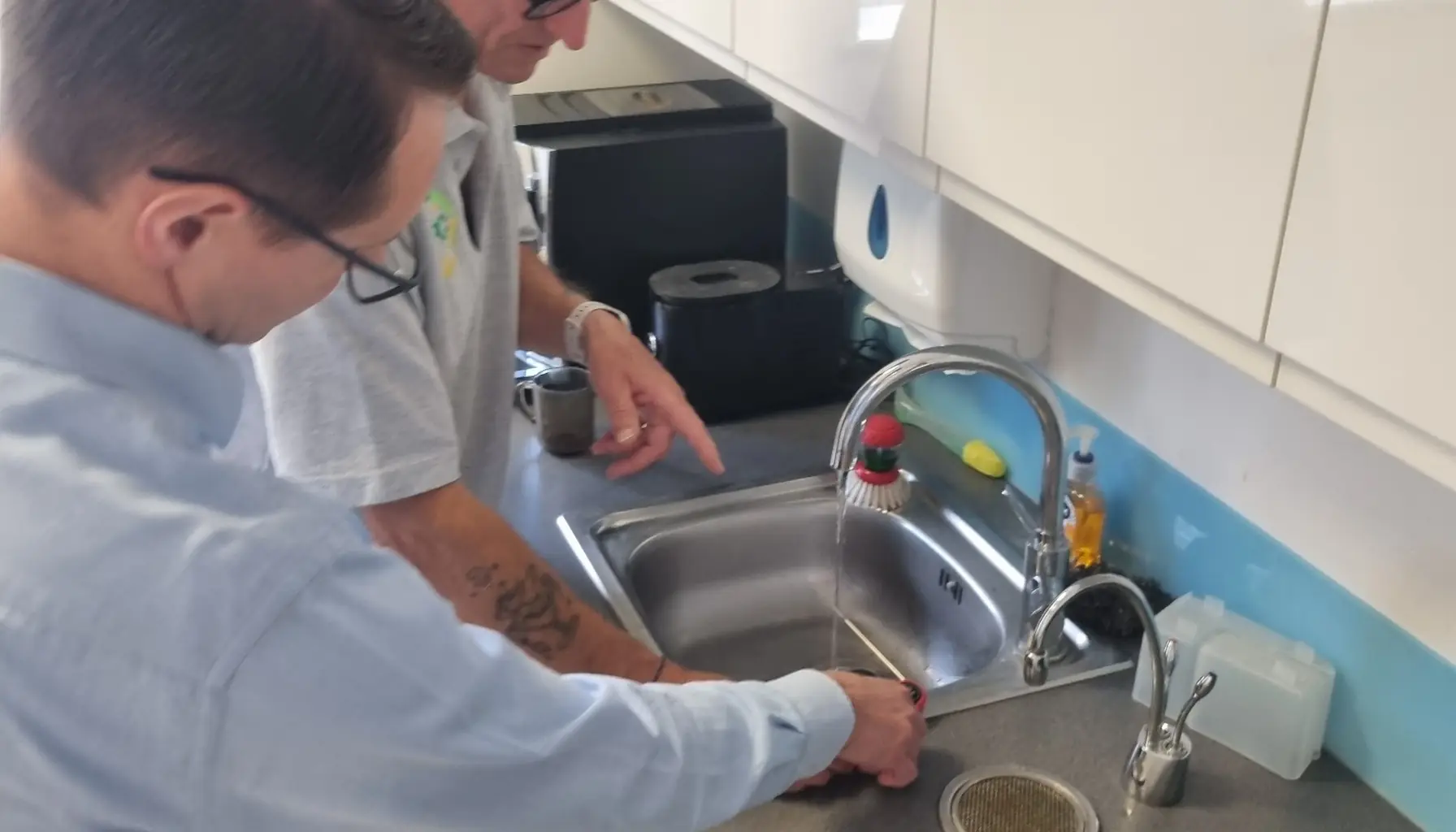
Who Is the Legionella Responsible Person?
The Legionella Responsible Person is the competent person appointed to take responsibility for managing identified Legionella risks and ensuring that appropriate control measures are implemented.
Under HSE guidance, this individual must have sufficient authority, knowledge, skills and competence to perform the role effectively.
Depending on the organisation, the Responsible Person may be:
- A business owner or employer.
- A facilities or maintenance manager.
- A school or nursery manager.
- A care home or healthcare facilities manager.
- A property or estate manager.
- A competent external specialist.
Appointing a Responsible Person does not automatically transfer all legal responsibility away from the dutyholder.
The organisation must ensure that appropriate arrangements, resources, information and training are available.
Are You Responsible for Legionella Water Safety?
If you manage premises, oversee maintenance or have been appointed as a Legionella Responsible Person, it is important that you understand what the role involves.
Our online Legionella Responsible Person training helps learners develop an understanding of their responsibilities, risk assessments, control measures, temperature monitoring and record keeping.
View Responsible Person TrainingOnline Legionella Responsible Person Training – Available Throughout the UK
Legionella Assessors provides online Responsible Person training for individuals and organisations across England, Scotland, Wales and the wider UK.
Although our risk assessment services are based in South Yorkshire, our online course is not restricted by location.
Whether you are in Rotherham, Doncaster, Sheffield, Barnsley, Leeds, Wakefield, Bradford, Manchester, Birmingham, London or elsewhere in the UK, you can access the online training without travelling to a classroom.
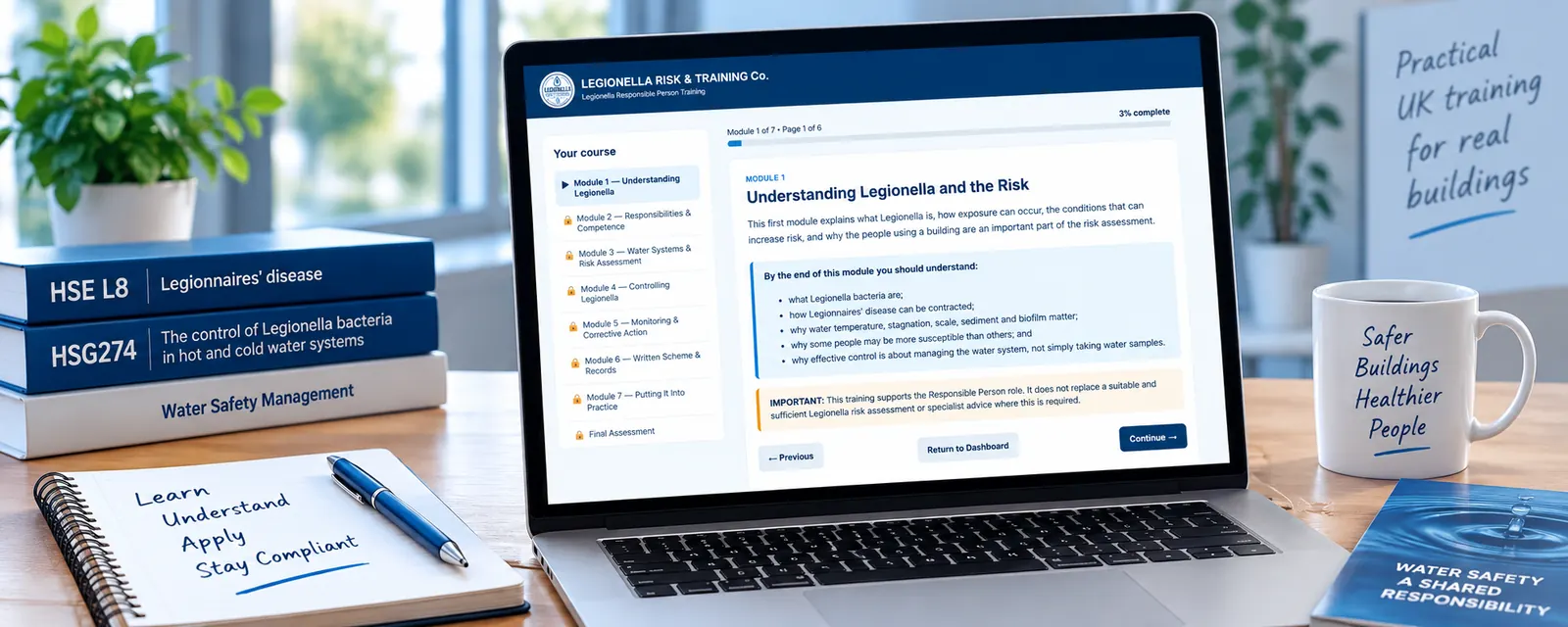
What Does the Course Cover?
The course is designed to develop practical understanding of Legionella risk management and the responsibilities associated with controlling water systems.
Key learning areas include:
- Understanding Legionella and Legionnaires’ disease.
- Relevant UK legislation and HSE guidance.
- The duties of the Responsible Person.
- Legionella risk assessments and identified hazards.
- Hot and cold water temperature control.
- Routine monitoring and record keeping.
- Water-system management and control measures.
- Recognising problems and understanding when further action is needed.
The online course is structured into seven learning modules, with knowledge checks and a final assessment.
The final assessment contains 25 questions, with a pass mark of 80%.
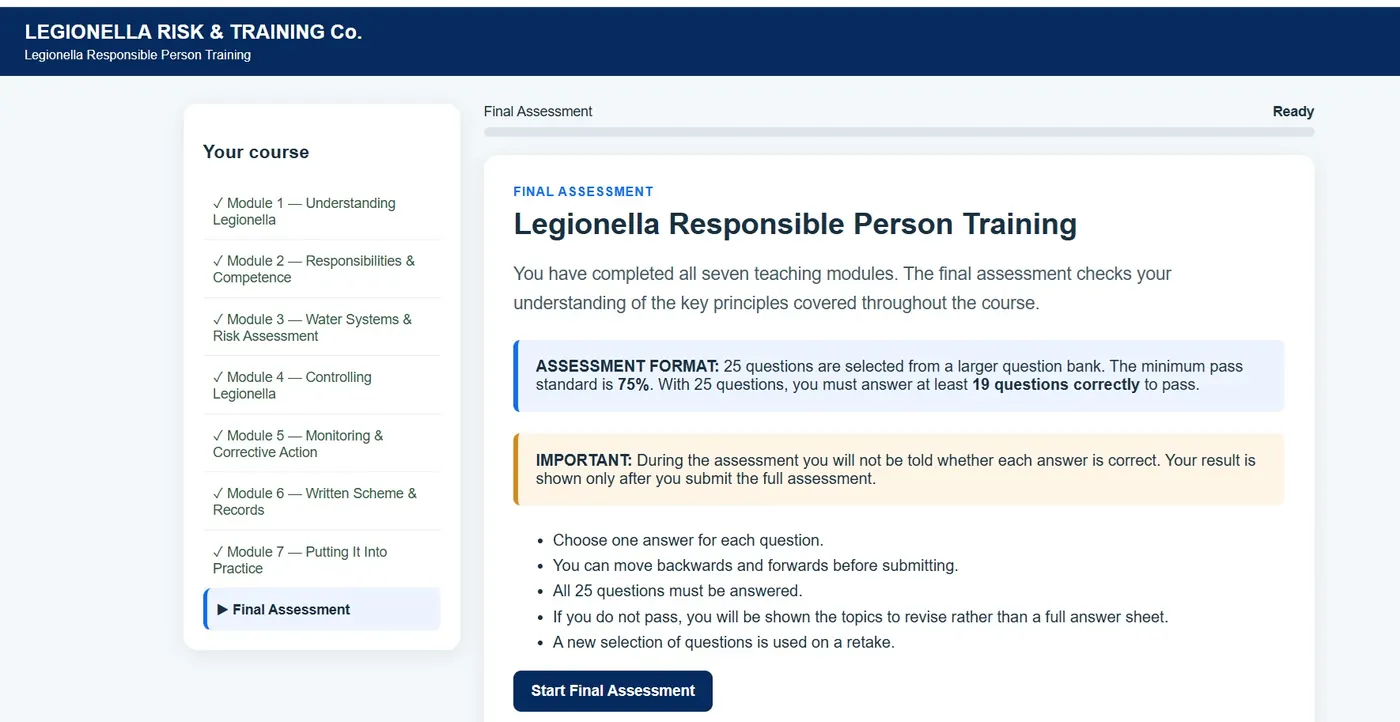
Online training supports the development of knowledge, but competence also depends on relevant experience, practical ability and familiarity with the water systems being managed.
A training course does not replace a suitable Legionella risk assessment or the need for site-specific control arrangements.
Why Responsible Person Training Matters
HSE ACOP L8 highlights inadequate management, lack of training and poor communication as factors that can contribute to Legionnaires’ disease outbreaks.
Suitable training helps those involved in Legionella control understand their responsibilities and recognise when corrective action or specialist advice may be necessary.
Practical Legionella Training for South Yorkshire Businesses
In addition to online learning, Legionella Assessors provides practical Responsible Person training for organisations in Doncaster, Rotherham, Sheffield, Barnsley and surrounding areas by arrangement.
Practical training can help staff understand the water systems they are responsible for and the monitoring procedures required.
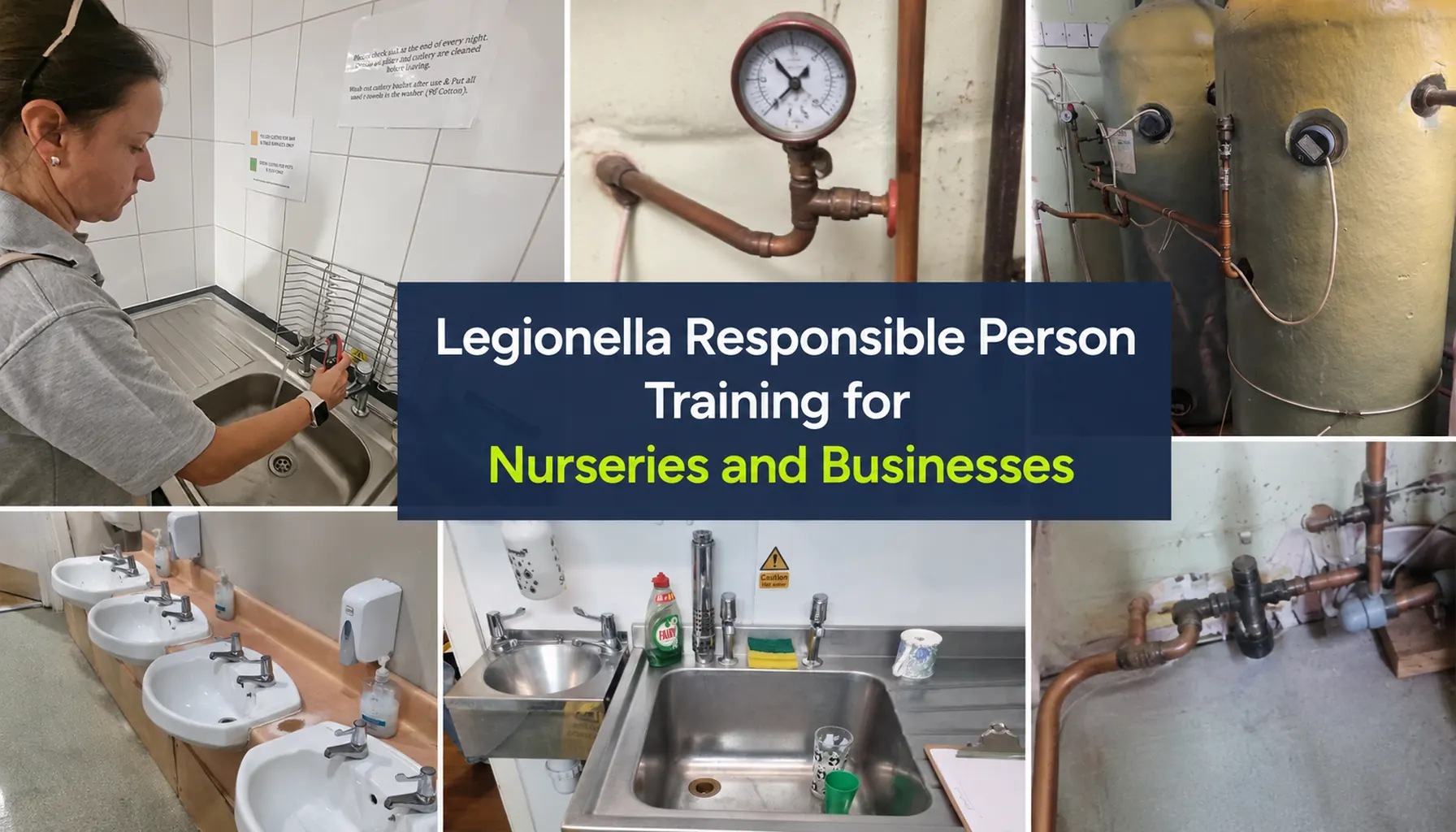
Nurseries and Businesses
Training for those managing water safety in nurseries, childcare premises and commercial buildings.
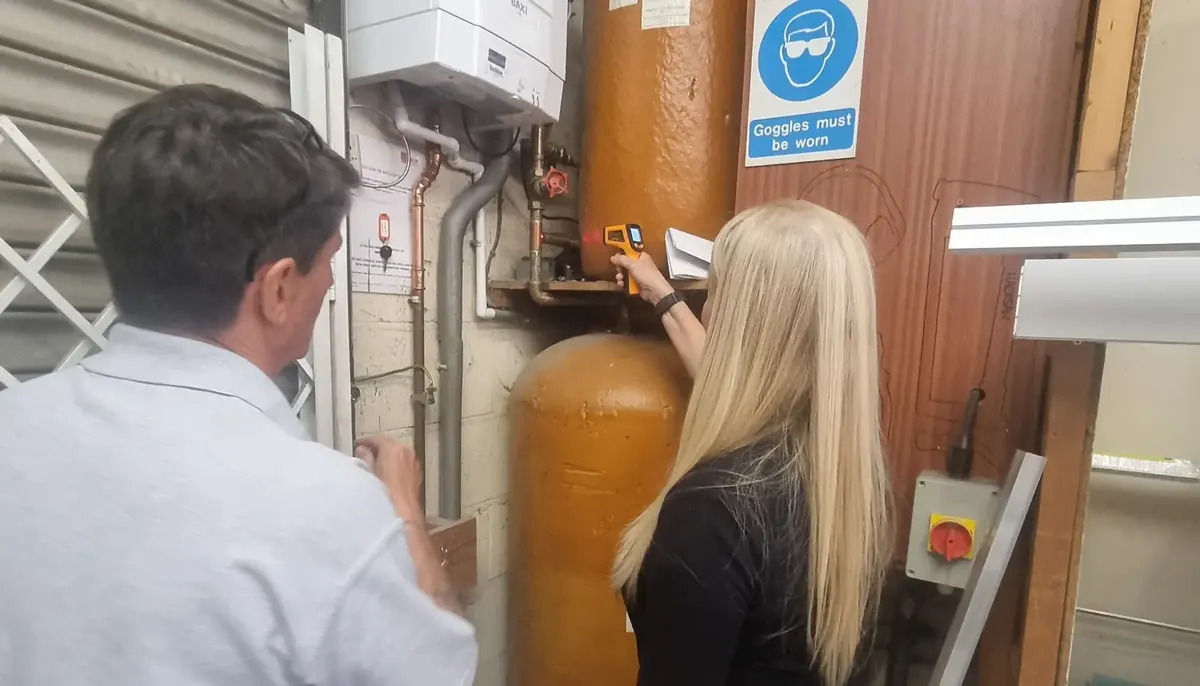
Temperature Monitoring
Practical understanding of hot and cold water temperature monitoring, recording results and recognising deviations from control limits.
Legionella Risk Assessments in Rotherham, Doncaster and South Yorkshire
Training is one important part of effective Legionella risk management. Organisations must also understand the actual risks presented by their buildings and water systems.
Legionella Assessors provides professional, proportionate Legionella risk assessments for landlords, businesses and organisations across Doncaster, Rotherham, Barnsley, Sheffield and surrounding parts of Yorkshire.
Our assessments consider the nature of the premises, water-system arrangements, potential exposure routes, existing control measures and areas requiring improvement.
Depending on the system, this may include:
- Inspection of hot and cold water systems.
- Identification of potential Legionella hazards.
- Relevant water temperature measurements.
- Assessment of stored and distributed water.
- Consideration of little-used outlets and stagnant pipework.
- Review of existing monitoring and maintenance arrangements.
- Practical recommendations and a written risk assessment report.
Our approach is proportionate to the premises and the level of risk identified.
We work with small businesses, landlords, property managers, schools, nurseries, care settings and other organisations.
Need a Legionella Risk Assessment in South Yorkshire?
If you own or manage premises in Doncaster, Rotherham, Sheffield, Barnsley or surrounding areas, contact Legionella Assessors to discuss your requirements.
Enquire About a Risk Assessment Commercial Risk AssessmentsWhat Should a Responsible Person Check Following the Rotherham Reports?
The recent Rotherham investigation does not mean that every building in South Yorkshire has a Legionella problem.
However, it provides a useful opportunity for dutyholders to review their existing water safety arrangements.
1. Review the Legionella Risk Assessment
Check that the assessment reflects the current building, its occupants and the water-system arrangements. Review it when relevant circumstances change or existing controls may no longer be effective.
2. Confirm Who Is Responsible
Ensure the dutyholder, Responsible Person, maintenance staff and external contractors understand their roles.
3. Check Temperature Controls
Where temperature is used as the control method, the usual HSG274 hot and cold water benchmarks include hot water storage at 60°C, hot water distribution reaching at least 50°C within one minute, and cold water below 20°C within two minutes.
Different or additional requirements may apply in healthcare settings, at thermostatically controlled outlets and where alternative control methods are used.
4. Review Little-Used Outlets
Identify outlets that are used infrequently and ensure appropriate arrangements are in place to minimise stagnation.
5. Check Monitoring Records
Monitoring records should be meaningful, accurate and reviewed. Unexpected results should trigger appropriate investigation and corrective action.
6. Check Staff Knowledge and Training
Staff carrying out monitoring or implementing control measures should understand what they are doing, why it matters and when to report a problem.
Not sure whether your Responsible Person has received suitable training?
View our online Legionella Responsible Person training .
Frequently Asked Questions About the Rotherham Legionella Outbreak and Legal Duties
Has the source of the 2026 Rotherham Legionella outbreak been identified?
As of 11 October 2026, the public reporting reviewed has not identified a confirmed common source. UKHSA is investigating possible links between cases.
Was the Rotherham outbreak caused by a council property or private landlord?
The source of the recent cases has not been publicly established. Separately, Rotherham Council has reported an ongoing Legionella contamination issue at a social housing complex that it does not own or manage. No connection between the two matters has been confirmed.
Have there been arrests or prosecutions?
No arrests, charges or prosecutions directly associated with the October 2026 investigation were identified in the public reporting reviewed for this article. Investigations may continue.
Do private landlords need a Legionella risk assessment?
Yes. Private landlords have a duty to assess and control the risk of exposure to Legionella. For many straightforward domestic properties, a simple and proportionate assessment may be sufficient.
Is a professional Legionella certificate a legal requirement?
No. HSE guidance does not require every domestic landlord to obtain a professional Legionella test certificate. The legal requirement is to assess and appropriately control the risk.
Does a business need a Legionella Responsible Person?
Employers and people in control of relevant premises must have suitable arrangements for managing Legionella risks, including appointing a competent person to take responsibility for controlling identified risks.
Can I complete Legionella Responsible Person training online?
Yes. Legionella Assessors provides an online Responsible Person training course accessible throughout the UK. Online learning supports knowledge development, although practical competence and familiarity with the actual water system are also important.
Do you provide Legionella assessments in Rotherham and Doncaster?
Yes. Legionella Assessors provides risk assessment services across Doncaster, Rotherham and surrounding parts of South Yorkshire, subject to the premises and scope of work. Online training is available nationally.
Legionella Safety Is an Ongoing Responsibility
The Rotherham investigation highlights the importance of taking Legionella risks seriously while allowing public health investigators to establish the facts.
Effective water safety management requires more than a document filed away after an assessment.
It requires clear responsibilities, appropriate control measures, competent people, suitable monitoring and action when problems arise.
For landlords and businesses across Rotherham, Doncaster and South Yorkshire, this is an opportunity to review whether existing arrangements remain suitable.
For organisations throughout the UK, our online Responsible Person course provides a structured introduction to the knowledge needed to help manage Legionella risks.
Take the Next Step Towards Better Legionella Risk Management
Whether you need to develop your knowledge as a Responsible Person or arrange a professional risk assessment, Legionella Assessors can help.
Explore the Online Training Course Contact Legionella AssessorsOfficial Guidance and Information Sources
This article draws on public reporting and official guidance available as of 11 October 2026.
- BBC report – UKHSA investigating Legionnaires’ disease in Rotherham, 7 October 2026
- Rotherham Council meeting records, 9 September 2026
- HSE – Legionella and landlords’ responsibilities
- HSE – Managing Legionella risks and the Responsible Person
- HSE – Approved Code of Practice L8
- HSE – HSG274 technical guidance
Editorial note: This article provides general information and does not identify any organisation as responsible for the October 2026 Rotherham cases. Public health investigations remain subject to further findings.
